


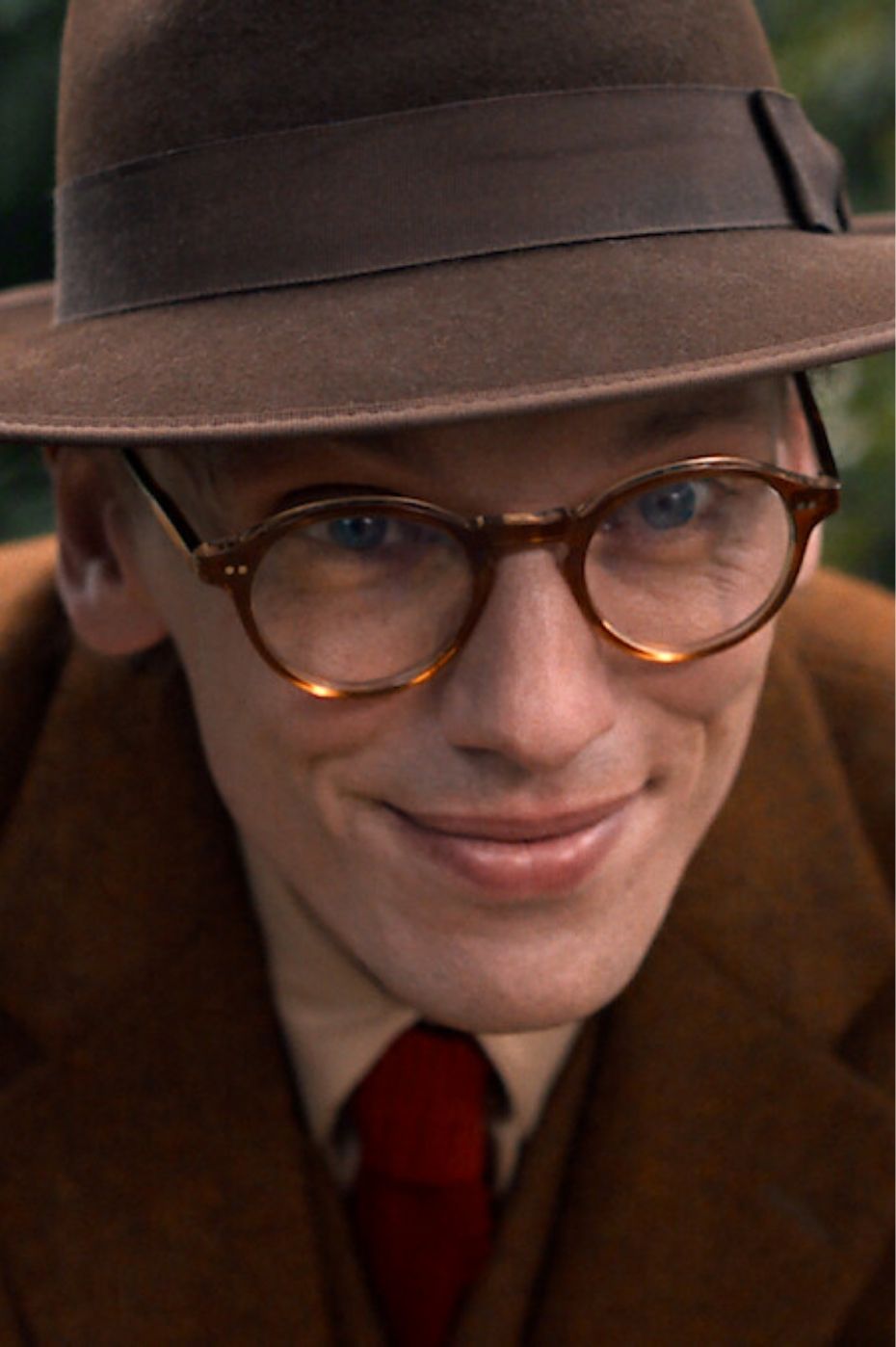
Photo Credit: https://www.netflix.com/tudum/articles/stranger-things-5-mr-whatsit
Stories are like colored glass. They alter what we see through them. It's one thing to say, "Jesus is King." It's another to say, "Aslan is like Jesus." The latter brings a world of Narnian connotations and associations with it: speaking beasts, an ancient curse, a broken table, resurrection. Once you give a head-nod to a story, the color of your message changes. That's why allusions to books and movies within a piece of media add a layer of complexity, power, and depth. Everything gets deeper when you embed one story within another. So, I was intrigued when I noticed the show Stranger Things continually referencing Madeleine L'Engle's A Wrinkle in Time. What complexity, power, and depth does that add?
It would help to note what's going on in A Wrinkle in Time and what's taking place in Stranger Things. More specifically, how does each story portray good and evil? What is each story fundamentally about? The answers to those questions, in addition to the connections between the two narratives, introduce new "colors" for readers and watchers.
A Wrinkle in Time
L'Engle's masterpiece A Wrinkle in Time (1962) tells the story of Meg Murry, whose brilliant father discovered how to time travel but has been lost for over a year. It falls to Meg to find him. But she needs help, from three mysterious and angelic figures (cosmic guardians who are actually stars): Mrs Whatsit, Mrs Which, and Mrs Who. Mrs Whatsit is a quaint grandmotherly figure: draped in clothes too big for her, donning a felt hat and a pink stole (shawl). Her gray hair is tied into a knot on the top of her head, and her voice is "like an unoiled gate, but somehow not unpleasant." She seems most relatable and calming. Mrs Who is a "plump little woman" with huge glasses, often quoting philosophers and sages in several different languages: French, Latin, Greek. And Mrs Which, the most bizarre of the three, has trouble fully materializing in a physical form. When first introduced, "in a circle of silver something shimmered, quivered, and the voice said, 'I ddo nott thinkk I willl matterrialize commpletely. I findd itt verry ttirinngg.'" These three guide Meg, her little brother Charles Wallace, and Calvin (Meg's friend) through time and space via a tesseract, a "wrinkle" or fold in space-time that allows people to travel massive distances in a matter of moments. And so they journey across the galaxy.
Stories are like colored glass. They alter what we see through them.
But evil lurks. The Black Thing—a silencing, isolating, and overwhelming darkness—threatens to swallow them up, as it has entire planets. One of those "dark planets" is called Camezotz, where Meg's father is being held prisoner. (Note that one of the episodes in Stranger Things Season 5 is called "Escape from Camezotz.") Upon arrival, they discover that Camezotz is a place completely uniform and perfectly controlled. There is no diversity, only sameness. The thing that controls this planet is another manifestation of evil called IT, a brain-like shape that "pulsed and quivered, that seized and commanded. No wonder the brain was called IT. IT was the most horrible, the most repellent thing [Meg] had ever seen." IT forces all the inhabitants of the planet into uniformity.
In what might be one of the most important sentences in the book, Meg fights back against IT as it speaks through her brother Charles Wallace. As they discuss the importance of equality, IT says, "That's exactly what we have on Camezotz. Complete equality. Everybody exactly alike." Meg replies, "Like and equal are not the same thing at all!" It's a powerful line, showing that diversity and equality are meant to co-exist. Maniacal control of all creatures by one being is the definition of evil.
And goodness—where does that come from? Goodness is found much higher than the creatures in the story. L'Engle's Christian faith shines through in several places of the book with biblical quotations, revealing that God is the source of all goodness. Mr. Murry, after being rescued, quotes Romans 8:28 (the entire verse, not just the first part), and Aunt Beast, a blind alien who cares for Meg later on, quotes 2 Corinthians 4:18. When you have aliens quoting the Apostle Paul, it's clear who the ultimate authority on truth and goodness is. Oddly enough, many readers of A Wrinkle in Time miss this entirely or downplay it. But for all intents and purposes, God is very much at the heart of L'Engle's book (and her work as a whole). He's just not foregrounded, and some would argue that this reflects our own experience more naturally.
So, evil in A Wrinkle in Time is a silencing, all-controlling darkness that consumes people, places, and planets. It uses instruments such as IT to carry out its work. Goodness and salvation come through personal love and grace, which ultimately breaks through from a place of transcendence (God). There is also a humanizing element to goodness. The God of goodness lets people be themselves: unique and limited. This doesn't mean God is not involved in daily life or in the formation of human personality. It just means that people are made by God with a free will and a heart that chooses either light or darkness. We see the darker side of this choosing in L'Engle's book An Acceptable Time (part of the same series), when a main character chooses the darkness of self-salvation at the potential cost of another person's life.
Now, keep this approach to good and evil in mind, and use it as a looking glass for Stranger Things Season 5.
Stranger Things
In Stranger Things Season 5, Holly Wheeler develops a relationship with someone she calls Mr. Whatsit. She happens to be reading A Wrinkle in Time and carries a copy of it everywhere. Mr. Whatsit is promising to protect her from monsters, mirroring the guidance and care of Mrs Whatsit. But we quickly find out that Mr. Whatsit is really Venca, who has infiltrated Holly's mind and is working out a plan to deceive her and eleven other children from Hawkins. He aims to carry out a nefarious scheme to destroy the world. In that sense, Venca is very much like IT. Maybe the Mind Flayer, a giant alien with psychokinetic powers, is like The Black Thing, forcing Vecna to do his bidding. In fact, it's no exaggeration to say that the Mind Flayer is trying to turn Earth into a "dark planet."
Some of the kids from Hawkins end up calling Vecna The Black Thing, which is understandable. It's not been clear to me whether The Black Thing and IT in L'Engle's work are really the same being in different manifestations. Regardless of the specifics, Vecna is clearly trying to use Mrs Whatsit from the book as a cover for his true identity. And it's the ideal cover: a dark evil parading as an angel of light, clearly evocative of Satan, or of Morgoth in Tolkien's The Silmarillion.
Also like The Black Thing and IT, Vecna and the Mind Flayer are bent on control and consumption. Vecna appears to enter the minds of his victims, often through some sort of pain or mistake or sin. And then, by the entrance of that pain, he overtakes their conscious life. Dr. Brenner, the one leading the Hawkins Lab experiments, says that Vecna doesn't just kill his victims; he consumes them entirely—their memories, mental capabilities, and experiences. This is reminiscent of the biblical description of Satan as a prowling lion always on the lookout for the next person to devour (1 Pet. 5:8).
Stranger Things portrays evil as a desire to control, consume, and destroy. This has many overlaps with L'Engle's portrayal, though it leaves out IT's aim of erasing all diversity.
But the series also has a take on what's good in the human condition. In another article, I suggest that the following emerge from the show as "goods," or things most highly valued in the narrative.
- The power of the mind
- The importance of personal relationships
- Friendship character traits (loyalty, joint-resilience, compassion, love, trust)
- Self-Sacrifice
However, in contrast to L'Engle's work, Stranger Things depicts these goods as purely human. The narrative has no transcendental ties to God. To use the language of Charles Taylor, Stranger Things and the world of Hawkins are trapped in "the immanent frame" (A Secular Age). They cannot (or will not) access the supernatural, despite the paranormal and (eventually) alien intrusions that define the series.
No one's attempt to shut God out of the picture succeeds in the end.
Like every person, the story of Stranger Things wants to reject the supernatural but can't (cf. Rom. 1:18-21). The longing for transcendence leaks through the cracks in the narrative and the spaces between the characters. No one's attempt to shut God out of the picture succeeds in the end. The longings and values run too deep and too high. God always gets through. L'Engle embraced that.
Complexity, Power, and Depth
Adding L'Engle's book into the story of Stranger Things brings complexity, power, and depth. The complexity comes in the messiness we meet when trying to match the two narratives. Is Holly's attempt to find safety meant to parallel Meg's attempt to save her father? What does "salvation" look like in each story? Does a lack of correspondence between goodness in Stranger Things and goodness in A Wrinkle in Time mean the allusion to L'Engle's work is somehow shallow? Is Holly the corollary to Meg Murry, or are the connections between both stories meant to be loose? The abundance of questions suggests there are no simple answers. In fact, the answers may shift depending on whom you talk to: the Duffer brothers, the actors and actresses, the fan base.
The power comes in combining a beloved book with a beloved TV series. L'Engle's book won the Newberry award for "Most Distinguished Contribution to American Literature for Children." It has a broad fan base and a history of interpretation to match. Stranger Things has been the most successful English show Netflix has ever launched. Combining the two stories means you ignite excitement, passion, and memory on both sides. It was a perfect storm. And one writer at the New York Times believes it was no accident. Stranger Things has shown it knows how to draw on nostalgia to swell enthusiasm.
The depth comes through deeper questions. What really is the nature of evil? How does it work? How does it infiltrate people and consume them? Is it like what happens with Vecna, where inner dissatisfaction and isolation spill over into contempt, and then that gets harnessed by a darker force of evil? Or is evil more like what happens with Meg Murry, where she's assaulted by darkness from the outside, an impersonal darkness that seeks to destroy the good order? Is it both?
And what about goodness, hope, joy, and longing for unending relationship? Where do those things come from, and where are they going? Do we have reason to be hopeful about the constant changes and obstacles we meet? Are we destined for something transcendent, or are we trapped in a world that constantly frustrates and disappoints us? Will our longing for light and peace and relationship find fulfillment?
We are characters in a massively complex story. We even have an invitation from the author to commune with him.
These are the sorts of penetrating, perennial questions that we're constantly bumping into in everyday life. And the characters—both in L'Engle's work and in Stranger Things—bump into them too. That's why we resonate with them. That's why, in a mysterious sense, we love them. Think about how strange that is: we feel deeply about characters who have been created in the minds of others. We care what happens to them. And maybe that's because we care what happens to ourselves. We are, after all, characters in a massively complex story. We even have an invitation from the author to commune with him.
Questions
Despite all these fascinating connections between Stranger Things and A Wrinkle in Time, we are left with open-ended questions. And that's a good thing. It reveals the differences between the stories. L'Engle's work is about saving what was lost and growing in the process. It says, "We need help to defeat evil and recover what is precious." Stranger Things is about fighting otherworldly evil in order to retain "this-worldly" goods. There is a void where transcendence should be. And yet, the story invites transcendent inquiry. What really happened to Eleven? What purpose are the other characters' lives unfolding towards? The answer cannot be defined by the characters themselves; they lack control over their own lives, just as we do. It comes down to transcendence + faith (L'Engle) or "eat, drink, and be merry again" (Stranger Things). But there are enough holes in the narrative for Stranger Things to provide light for transcendence and faith. In the end, that's why I'm drawn to it.

.jpg)

.jpg)
.jpg)