


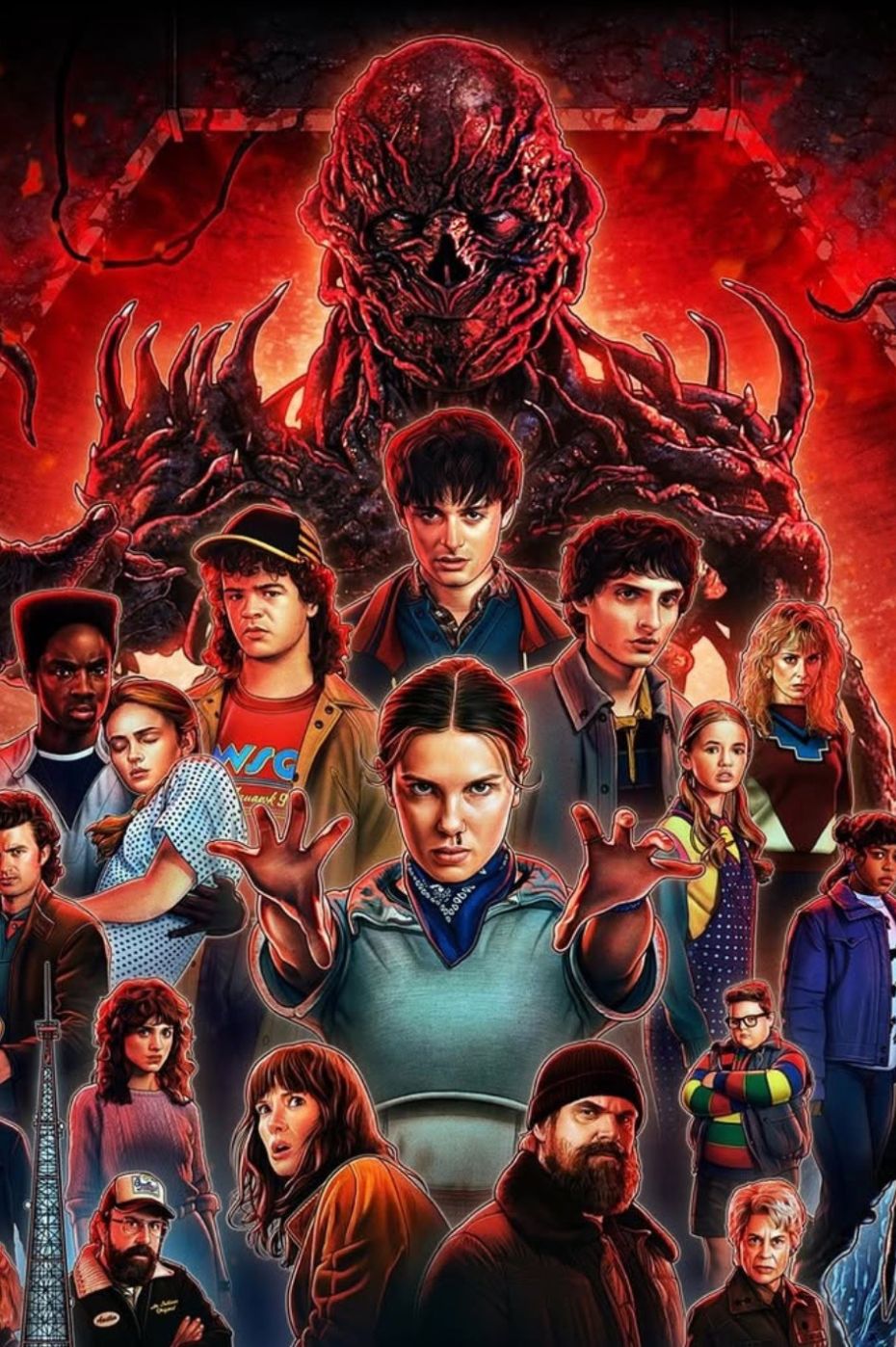
Photo Credit: Kyle Lambert at https://strangerthings.fandom.com/wiki/Stranger_Things/Season_5?file=Season_5_Final_Poster.jpg
Updated January 5, 2026, after the release of the fifth and final season.
Editor’s Note: This post references content that may not be suitable for all audiences. Westminster Magazine occasionally publishes reviews and perspectives on secular or unorthodox content in the interest of illuminating the arts and culture of a fallen creation with a biblical light. These posts are not intended as an endorsement or recommendation. Readers and parents should use judgment in choosing which books, shows, and music to enjoy.
Some people think theology is only written by theologians. It’s not. In fact, it’s written by everyone. Everyone has assumptions about three critical things: who God is, who we are, and what the world is like. Even if you think God doesn’t exist, that’s still an assumption. Even if you don’t state what your assumptions are, you still have them. And so, when people are creating art or expressing themselves in any form of media, there’s always a theology embedded in what they do. It’s unavoidable. It’s part of what it means to live in a world governed by God. And since Stranger Things has been one of the most popular series in recent history, continuing to be Netflix's biggest English-language debut ever, ruminating on its theology gives us access to a host of assumptions and values in secular culture. A theology of Stranger Things, in some sense, is a theology of contemporary Western entertainment.
WHY STRANGER THINGS?
But if everyone has a theology, if theology is embedded in all that we express, then why choose Stranger Things? I’ve got four reasons. First, I found the storyline and character development creative, gripping, and believable. By “believable,” I mean that I truly thought the characters would have developed in the way they were portrayed. One of the fundamental truths about humans is that they always develop; they always change. We just aren’t capable of looking in all the places where it might happen. Plus, since people are inconsistent, spotting change can be a tricky business. That's one of the draws of a TV series or film: we get to watch character development unfold.
Everyone has assumptions about three critical things: who God is, who we are, and what the world is like.
Second, I found a lot of places in Stranger Things where theology intersected with art. Here are some that stuck out to me.
- The nature of evil (as a desire to control or destroy)
- The nature of good (interpersonal love, meaningful human experiences/relationships)
- The role and power of our minds
- The highest purpose of life (self-sacrifice)
- The longing and hope for a “savior” figure
Third, as I noted above, Stranger Things is wildly popular and has an almost cult-like following. It recently became the second ever Netflix series to pass 1 billion hours viewed. [1] The fifth and final season even led to theater viewings given its mass popularity, and many cast members appeared on The Tonight Show with Jimmy Fallon. It is what media theorists call a "transmedia phenomenon." It goes well beyond the walls of Netflix and has created a culture in comics, novels, games, merchandise, and other immersive experiences. In short, it built a sub-universe that deepened engagement through multiple platforms and created an extensive, interconnected pop-cultural brand. Thinking about its theology thus reveals a whole lot about what sorts of concepts and values the masses are drawn to, and perhaps why they’re so drawn.
Fourth, I love the 1980s. I know that doesn't sound like a reason, but stay with me. Maybe it’s a millennial thing, but nothing holds my attention like those hightop white sneakers, 80s wash jeans, and “Shout” by Tears for Fears blasting in the background. I couldn't explain it before, but it's not accidental. One writer from The New York Times says the show is "an entertainment machine built by repurposing vintage pop-culture parts," everything from E.T. to Kate Bush and The NeverEnding Story. The nostalgia that comes through for a large swath of viewers is potent. For James Poniewozik, Stranger Things "succeeds in part because of how well it evokes pop culture that audiences already love. It is, in other words, a human-made equivalent of the algorithm, the software engine that has come to define the experience and the aesthetic of streaming." The Duffer brothers certainly knew what they were doing when tapping into the 80s.
We can break down the theology of Stranger Things into three categories: who God is, who we are, and what the world is like.

.jpg)

.jpg)
.jpg)