



“The hearts of the children of man are full of evil, and madness is in their hearts while they live” (Eccl. 9:3)
Madness. Insanity. We hear these words in different contexts, though not as often as we once did. The terms are derogatory now. And yet what they signify is very much with us. Madness is either “a state of severe mental illness” or “behavior that is very foolish or dangerous.” But the question for us isn’t just what madness is but what causes it. There are three common approaches: body, mind, and heart.
- Is madness a problem of the body—hormones and internal systems gone wild?
- Is it a problem of the mind—psychological breakdown of some sort?
- Is it a problem of the heart—the roots and shoots of sin and evil or disordered desires?
Of course, things are more complicated than a three-category approach suggests. For any given situation, all three dynamics are likely in play. But since I’m a Christian theologian, I focus on what Scripture teaches about the heart. Solomon wrote that madness is a heart issue. And the biblical counselor David Powlison (1949–2019) would say that our hearts are “unsearchably insane.” What does this mean, and why does it matter? Answering those questions brings out the legacy of David Powlison and points the church forward in its discussions of mental health and counseling.
For Christians, our sanity will always be found in God as he teaches us to dissect our own hearts with Scripture. I’ll show you how to do that in a moment. Let me first set out what David Powlison meant with his language, why it matters, and how we take up the practice of dissecting our hearts.
Insane Hearts
David Powlison’s language has a way of cutting through the fog of confusion. He deals in fresh vision. Most of us are used to hearing “insane” attached to mental activity, so I was struck by his frequent references to “hearts” being insane. Here’s a sampling:
- “The madness in our hearts generates warped spectra. But God sees all things in bright, clear light—and this God is the straightener of crooked thoughts. He makes madmen sane.” (Seeing with New Eyes, 10)
- “The only sanity is to know Him-who-is. Anything else perpetuates our insanity.” (Speaking Truth in Love, 169)
- “The core insanity of the human heart is that we violate the first great commandment. We will love anything, except God, unless our madness is checked by grace.” (The Biblical Counseling Movement, 290)
- “The God of the universe calls us to love him with utter devotion. When I forget my Shepherd, I orient my life around another god and love some good gift more than the Giver. . . . I am commanded to the sanity of love, and it lays my heart bare.” (Good & Angry, 164)
- “In Christ, in order to sin, you must relapse into temporary insanity, into forgetfulness. It is your worst cancer, your most crippling disability, your most treacherous enemy, your deepest distress.” (God’s Grace in Your Suffering, 80)
- “Hearts may be unsearchable and insane, but the word of God reveals the thoughts and intentions of the heart (Heb. 4:12–13).” (The Pastor as Counselor, 33–34)
Sanity, for Powlison, is a matter of the heart. It’s a matter of knowing and loving God as he reveals himself in Scripture. When the thoughts or desires of our heart violate God’s will, we are insane. When we chase after something more than we chase after God, we are insane. When we love anything as ultimate beside the Father, Son, and Spirit, we are insane. When we refuse to let the piercing word of God examine and reveal our motives, we are insane. In order to be sane, we need grace, forgiveness, love, and renewed heart orientation from the one who sets all things in their perfect place. Sanity is a matter of divine-human relationship. To be sane is to be right with God.
Sanity is a matter of divine-human relationship. To be sane is to be right with God.
That does not discredit or dissolve the concept of insanity when it comes to physiology (hormones and chemical imbalances, brain development) or psychology. But it does reveal something widely overlooked in discussions of mental health: God matters. In fact, he doesn’t just matter; he’s central. He is, as Powlison would say, the sun around which the planet of our life turns.
From this perspective, insanity is a far more pervasive problem than even the bleakest mental health statistics suggest (and statistics are pretty bleak right now). A top-notch businessman with a stable job, loving family, and solid “mental wellbeing” could very easily be insane. That insanity could show itself in his lustful or ambitious thoughts, in his disordered loves, in professional pride or egoism, in the treatment of his spouse as a means for self-satisfaction. Heart insanity is expertly camouflaged and knows no boundaries. It’s invisible on the surface but pervasive to the pith, growing out of diseased hearts like black mold on forgotten fruit. On the outside, a majority of people appear sane. On the inside, people fall under Solomon’s judgement: madness is in our hearts (Eccl. 9:3). We are unsearchably insane until and unless Christ calls us out of ourselves and grants us a new heart. And even then, the insanity of sin tugs us down. Only grace can give wings.
How To Dissect Your Heart
So, how do we respond when our hearts are insane? We dissect them. David Powlison drew on Scripture to present a way forward, and it’s a great path for the church to continue investigating as it gets deeper into discussions of mental health. We might set out heart dissection in three steps: check your motive, repent, and believe. Doing this repeatedly by reading Scripture is what keeps us sane.
1. Check Your Motive
Start with motive: Why do you do what you do? We fail to see how momentous that question is. Jesus told his disciples, “Where your treasure is, there your heart will be also” (Matt. 6:21). Our hearts always have a treasure, and that treasure is our motive—the thing prodding us to act. Motive is central to all human behavior. And it comes to the surface when we ask a simple question: Why? Powlison wrote, “The question WHY? launches a thousand theories of human nature. Why do people do what they do? An ‘answer’ to this question anchors each analysis of human personality, and every attempt to fix what ails the human race” (“X-Ray Questions,” 2).
We can summarize Scripture’s teaching by saying that our motives go in one of three directions: towards God, self, or idols.
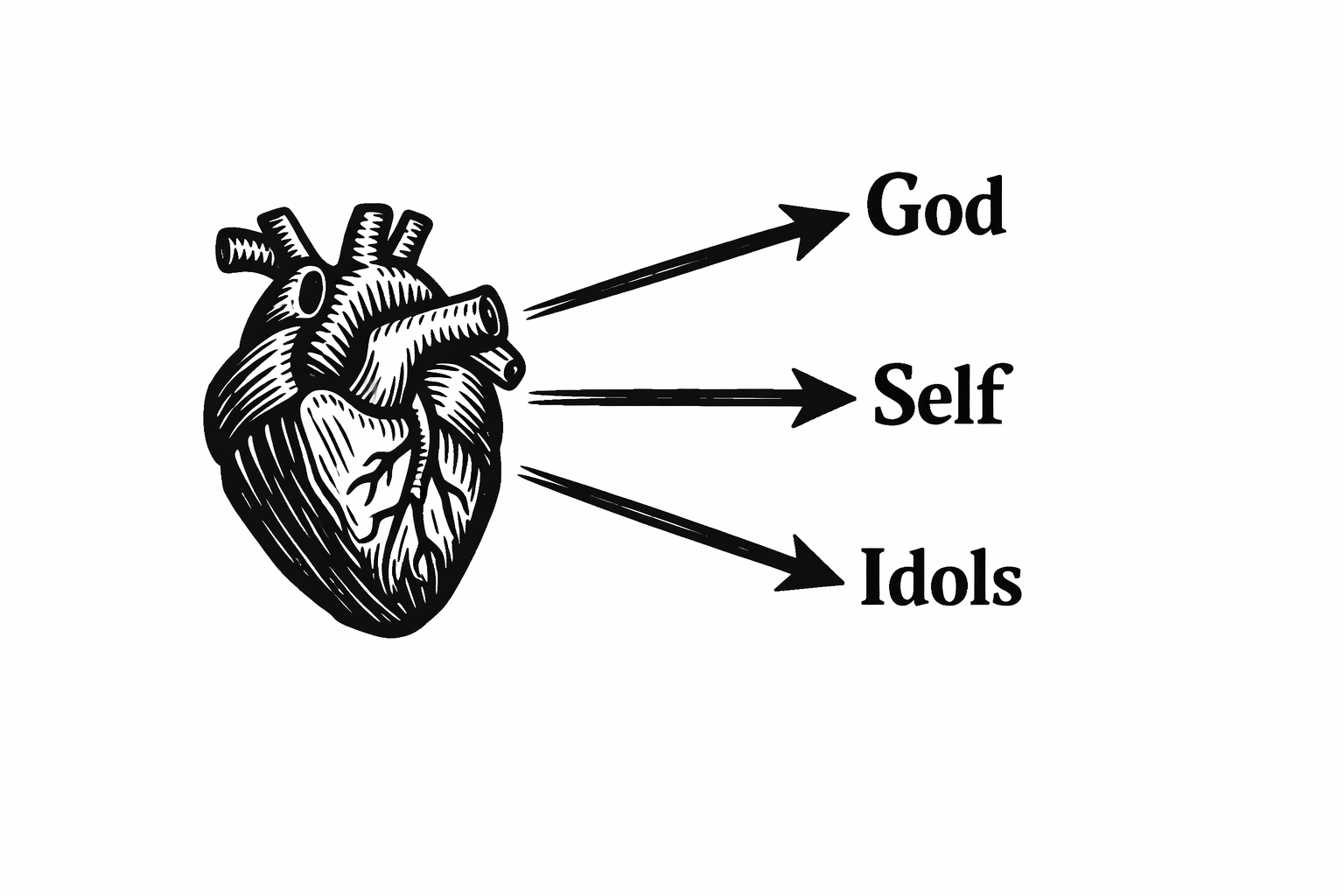
Our love for God and for our neighbor is the highest and holiest motive for any thought, word, or action. God’s Spirit is the only one who can foster those motives inside us, hence the beauty of God’s promise in the book of Ezekiel: “I will give you a new heart, and a new spirit I will put within you. And I will remove the heart of stone from your flesh and give you a heart of flesh” (Ezek. 36:26). With a Spirit-given heart, we can yearn for holy things.
But we constantly wage war against what Scripture calls “the flesh.” As Powlison put it, “The inwardness of motivation is captured by the inordinate and proud ‘desires of the flesh’ (1 John 2:16), our inertial self-centeredness, the wants, hopes, fears, expectations, ‘needs’ that crowd our hearts.” Desires of the flesh push us to love ourselves as the center of the universe. Many (maybe even most) of our motives are self-centered.
And then we can be motivated to serve idols, though few of us would use that language. An idol is anything other than God that is made ultimate. It is anything other than God about which we say, “If I can’t have that, then I won’t be happy. Without that, life cannot be good.” Powlison points out that desires of the flesh (self) and idolatry are actually part of a single thread of teaching in Scripture:
If “idolatry” is the characteristic and summary Old Testament word for our drift from God, then “desires” (epithumiai) is the characteristic and summary New Testament word for the same drift. Both are shorthand for the problem of human beings. The New Testament language of problematic “desires” is a dramatic expansion of the tenth commandment, which forbids coveting (epithumia). The tenth commandment is also a command that internalizes the problem of sin, making sin “psychodynamic.” It lays bare the grasping and demanding nature of the human heart, as Paul powerfully describes it in Romans 7. Interestingly (and unsurprisingly) the New Testament merges the concept of idolatry and the concept of inordinate, life-ruling desires. Idolatry becomes a problem of the heart, a metaphor for human lust, craving, yearning, and greedy demand.
A motive to serve self or to serve idols may be one and the same.
Those three directions for our motives set the foundation for our behavior. They reveal why we do what we do. So, how do we respond when it’s clear that we are motivated by self or idols? The Bible calls us to do something very simple: turn around.
2. Repent
Once it’s clear that our motive is not loving God or loving our neighbor, we have entered the realm of heart insanity. We begin living like those who despise God and reject him. We become darkened, foolish, and bound to futility (Rom. 1:21–22). What next?
Point the hull of your heart in the opposite direction, unfurl the sail of dependence, and beg the Spirit for wind.
Jesus’s keynote address in his ministry was simple: “Repent, for the kingdom of heaven is at hand” (Matt. 4:17). Repent. Turn around. Change course. Point the hull of your heart in the opposite direction, unfurl the sail of dependence, and beg the Spirit for wind. Whatever direction you’re facing with your selfish or idolatrous motive, do a 180. If you’re self-centered, ask God to be others-centered. If you’re full of lust, ask God to fill you with holy satisfaction. If you’re angry and bitter, ask the Spirit to open your eyes to the joy of forgiveness and gratitude. With Scripture as your guide, find the right direction for your heart, the Godward direction. And then ask the Spirit to turn your shoulders.
3. Believe
Faith is the final step, and it’s easy to miss. Many of us can be candid about our sinful motives, and we can ask God to help us repent. But believing that the Spirit of God will actually work—that’s a different matter. In the modern West, we are schooled in skepticism. We think doubt is a virtue. Herman Bavinck reflected on this in his classic The Certainty of Faith. Talking about his own time at the beginning of the twentieth century, he wrote, “A lust for doubt became the soul-sickness of our age, dragging a string of moral woes and miseries along with it” (The Certainty of Faith, 2). That’s our age, too. Our lust for doubt has become a soul-sickness that keeps us from believing in the invisible work and wonder of God. And yet Jesus was clear: “whatever you ask in prayer, believe that you have received it, and it will be yours” (Mark 11:24). This is true, of course, not for any wild request, but for those requests clearly aligned with the promised work of the Spirit, so that we might all love God and others with “a pure heart and a good conscience and a sincere faith” (1 Tim. 1:5). Faith, once again, is tied to love for God, which is what it means to be biblically sane.
Dissecting our hearts takes on this three-part activity as we fix our eyes on God’s word: checking our motive, repenting, and believing.
Case Study: Dissecting My Heart
What does this look like in real life? Here’s an example at the most rudimentary level. Watch how heart dissection pulls apart even the most common experiences.
I made a new kind of coffee this morning. I didn’t like it. It tasted artificial and flat. So, I was thinking about grinding another bag of beans and having a cup of good coffee. The problem of bad coffee can be solved by drinking more coffee, right? Let’s dissect my heart. We can use Isaiah 44:9, “All who fashion idols are nothing, and the things they delight in do not profit.”
Step 1. My motive was not enjoying the goodness of God through my coffee, which is what we’re meant to do with any earthly gift. It was to get a caffeine fix so I could plod through some writing and “feel better” while I’m at it. My motive was essentially self-serving (desires of the flesh). Or, you could think of it as quietly worshiping the caffeine idol. After all, I’m acting as if my morning won’t be “good” unless I have that. The idolatry comes to the fore with my proposed solution: drink more coffee to get a more pleasant caffeine fix. God’s word dissects my motive. The idol of caffeine (which is what I’m delighting in) will “not profit.” It won’t ultimately help me, despite any short term payoff. Idols always overpromise and underdeliver. Chasing caffeine, when left unchecked, is going to lead me to shame (Isa. 44:10–11).
Step 2. Before I went ahead to grind more coffee, God’s word revealed that my motive was off. So, I needed to repent, to turn around. What would it look like to be motivated to write for God, rather than to satisfy personal feelings? Well, it certainly wouldn’t look like making more coffee to get a better caffeine high (inward satisfaction). Instead, my motive should be facing outward; I should be others-focused. I don’t need more coffee to do that. I just need my heart redirected. So I pray quickly, “God, I’m sorry. My heart is in the wrong place. Would you move it?”
Step 3. Then I need to commit to believing that God’s going to answer that prayer. He’s going to work. His Spirit is going to grab my heart’s rudder and redirect me so that my motive and passion come from serving God and others.
Within fifteen minutes, I’m working on my writing without the nagging desire for coffee. Who cares that the coffee wasn’t good? Isn’t that what makes a good cup of coffee more enjoyable? And maybe tomorrow morning, I’ll actually look for God through my coffee cup, instead of having an opaque desire for caffeine. Remember that we are meant to see through the gifts we experience to the God who gives them. True gifts are always transparent, giving us vision of God’s character and faithfulness. He is the only one who truly profits us (Isa. 44:9), and he does that by giving us himself.
I know this example seems trite. But it shows that dissecting your heart works at any level—from having a disordered love of coffee, to slandering a friend behind his back, to confronting anger with a family member. Heart dissection is a daily (even hourly) practice that reveals our greatest treasure. Because our hearts are wayward, we’ll have many times throughout a single day to practice this. And if we keep it simple, it’s doable: check your motive, repent, and believe.
Conclusion: Heart Sanity
Dissecting our hearts leads to sanity. But central to that will be our ongoing embrace of God’s help, of our constant need for him. “Sanity has a deep awareness,” Powlison wrote. “I need help. I can’t do life right on my own. Someone outside of me must intervene. The sanity of honest humility finds mercy, life, peace, and strength” (Take Heart, 29). Dissecting our hearts and finding sanity is thus a practice of dependence. The more fully and consistently we depend on God to shape and guide our hearts, the closer to him we will grow.
——
Dissecting the Heart is a new book by David Powlison from Westminster Seminary Press. In this ground-breaking work, author and theologian Pierce Taylor Hibbs presents thirteen of Powlison's most penetrating lectures given between the 1980s and early 2000s. The result is a one-stop introduction to Powlison's thought and theology, with all of the psychological and theological background filled in for readers with content footnotes. Patently biblical, pastorally sensitive, and wonderfully engaging, this is David Powlison at his best, talking to his students, and to the church, with a heart for biblical wisdom and Christ-centered hope.


.jpg)

.jpg)
.jpg)