A number of book projects have fundamentally shifted or enhanced my perspective on the world. I still remember reading Vern Poythress’s In the Beginning Was the Word for the first time, which sent me headlong into a glorious study of the nature of language and its relationship to the Trinity. Several book projects came out of that study (The Speaking Trinity & His Worded World; Finding God in the Ordinary; The Trinity, Language, and Human Behavior), each of which both has shapedand will shape me for the rest of my life.
Since then, the most formative book project I’ve taken on is the recently released Dissecting the Heart: Secular Psychology, Spiritual Warfare, and True Theology (WSP, 2026). It’s a collection of 13 lectures by David Powlison (1949–2019), which I edited and annotated. That meant I spent over a year swimming in David’s thought: books, lectures, articles, and conversations with his loved ones and former students. I soaked in all I could. The project has shaped me in some profound ways. Here’s the highlight reel.
How Powlison’s Work Shaped Me
1. Everyone’s life has patterns—do you know what yours are? I took an old-school approach to research for Dissecting the Heart: reading paper books, highlighting key quotations, and indexing what I found with Post-it notes. I can’t tell you how many times I paged through these notes to draw together the best quotes from Powlison on a given topic from his lectures—whether it was motivation, the nature of Satan, or the function of human hearts. This process revealed the patterns in David’s thought, the things he spent hours and years meditating on and praying over. It also got me thinking about my own patterns. We all have them: patterns in behavior, patterns in thinking, patterns in speaking. What are yours?

It’s not that you have to notice them only so that you can change them all (that’s an option, of course, but only God can do it); it’s just illuminating to get a sense of “what you’re all about” or where God is currently working on your heart. If you know what your patterns are, you can enhance them, dive more deeply into them, or ask God to change them. Here are a few of my patterns, some positive and some negative. God is working to change the negatives!
- Using words as windows into who people are, what they think, or what the world is like (this means reading lots of books)
- Overthinking and growing anxious about . . . pretty much anything new
- Looking at everything around me as communicative of God’s character
- Forgetting God’s goodness whenever adversity strikes
- Finding real joy and lasting power in the Spirit of the resurrected Christ
2. God marks us so that we mark others. Having done this project and a similar one on J. I. Packer (forthcoming), it’s clear to me that the trends or patterns in a person’s thought—expressed in repeated words and phrases, restated arguments, and recurring emphases—reveal what has marked that person, what God has impressed on his or her soul. The marks are clear to such an extend that I can say with confidence something like, “David Powlison cared deeply about how we approach motivation” or “It meant a lot to David that we understand the heart’s pull toward idolatry.” These are things he spoke of and wrote about frequently. They marked him. In fact, God marked him with these biblical concerns. And, as a reader and writer, I am now marked by the same. I inherited the marks of my brother in Christ!
Marks that God makes on his people don’t just stay with them; impressions get passed down; travails travel.
Marks that God makes on his people don’t just stay with them; impressions get passed down; travails travel. One generation informs and shapes the next. It’s a special feeling to realize that you’re caught up in this God-governed process. It’s a comfort to know that whatever God shapes you with is going to be passed down to others. No one is an island. The fossils of one generation are molds for the next.
What is one way God has marked you, and how have you passed that along to others? Here’s one of mine: Deep struggles are entrusted to you so that you can bless others. That’s come out in light of my father’s early death and my decades-long battle with anxiety. I write about these things to pass down to others what God has passed to me. In light of that, I’m thankful to God and to David Powlison for giving me precious spiritual lessons and tools. We are all carrying marks.
3. The heart is at the center of everything human. This truth alone has already sparked two more book projects currently underway. I titled David’s book Dissecting the Heart because David was so enthusiastic about letting God’s word cut into our thinking, feeling, and willing—all of which happen in the central hub of the heart. The heart is the Bible’s comprehensive arena for everything that goes on inside us. David loved the way Scripture both cuts through the vines of heart-choking idolatry and opens the darkest places inside us to the holy light of God. (I highly recommend his article “Idols of the Heart and ‘Vanity Fair’”).
What is your heart chasing, and why? How does that chasing compare or contrast with what God tells you to chase after (i.e., his own glory and the character of Christ)? These are questions I think about constantly. They affect not just my writing but my parenting, my marriage, and my own spiritual development.
The heart is the Bible’s comprehensive arena for everything that goes on inside us.
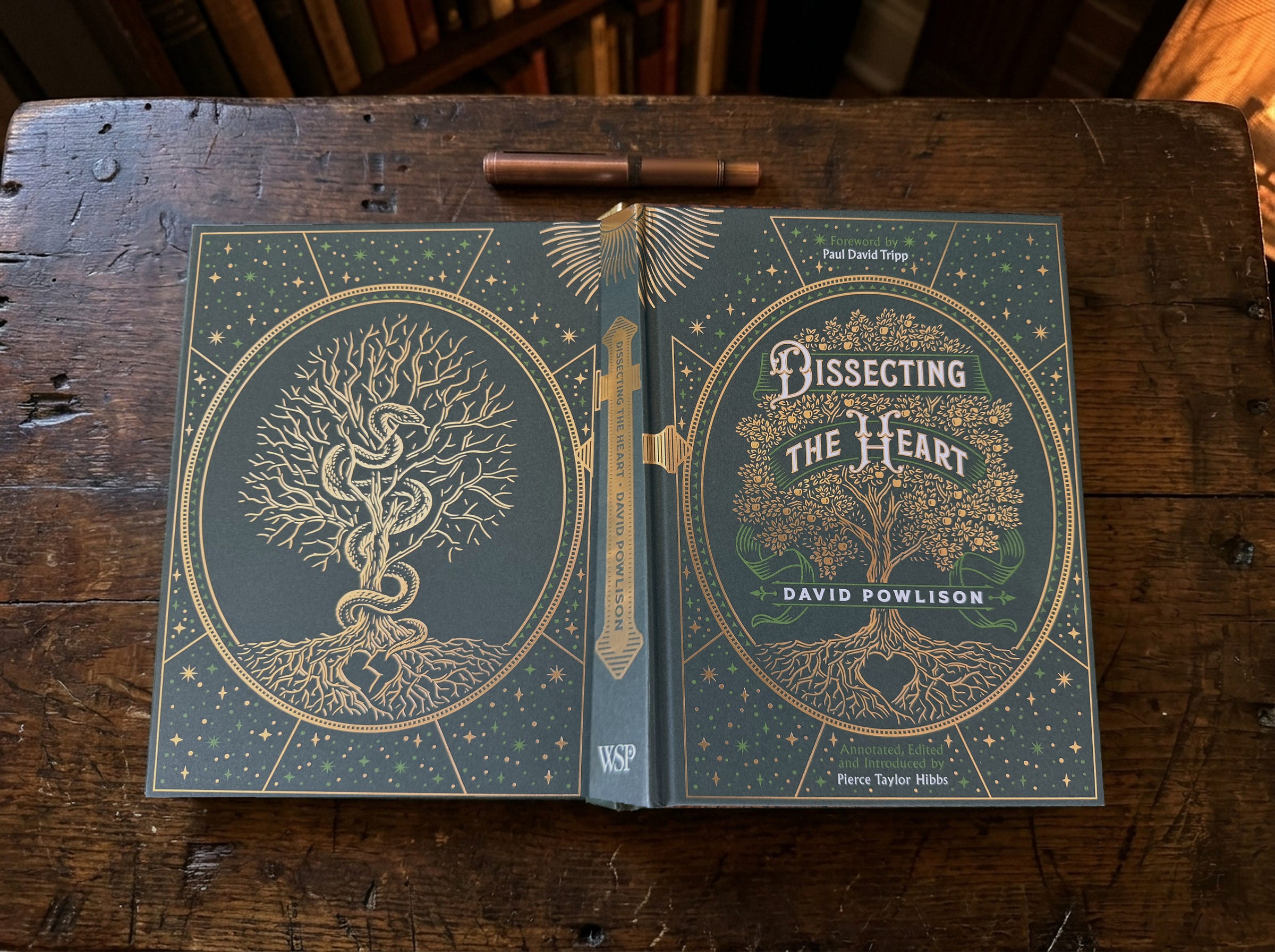
Take a look at the book’s cover design (those familiar with David’s teaching will recognize his “three trees” diagram, and a similar one is on page 245 of The Biblical Counseling Movement; Paul David Tripp has a nice one on page 95 of How People Change). Our hearts are always surrounded by healthy roots or thorns and thistles—usually both. Our sacred insides are ruled by the God of love or the serpent of sedition. There is never an experience for us that isn’t heart-centered or heart-shaping.
Practically, this means that far more of our attention needs to go not just to external behaviors but to the motives, desires, and ambitions beneath them. Instead of saying, “I need to stop doing X,” we should be asking, “Why do I keep doing X? What am I chasing after? What idols might I be serving?” Remember Jesus’s words: “out of the abundance of the heart his mouth speaks” (Luke 6:45). Look at the source of your behavior, and let God’s living and active word dissect it.
4. The words we use to label our problems matter. While I’m not opposed to the use of all language that comes from psychological or mental health culture, I am deeply aware of how our diagnoses control which cures we pursue and what we believe ails us. I have told people for many years that I have an “anxiety disorder.” But some people will interpret that phrase without any reference to God, as a purely physiological problem. But I’ve learned how that’s a half-blind approach to prevalent human struggles. Of course there are physiological components to our suffering. Of course our bodies are broken and decaying. These things matter. But dealing with anxiety (and any other form of mental suffering) has everything to do with God—how we trust him in the midst of suffering, what we look to for hope and comfort, why we respond to life’s pressures in a given way. We live in a culture that wants to make almost everything primarily biological and almost nothing spiritual. When popular terminology emerges from that context, then it’s no surprise that God gets pushed to the margins.
All of this means we need to be careful and intentional about how we describe our problems. This doesn’t necessarily require removing the language our culture references (though sometimes it will mean that). But it does demand that we reinterpret that language so that God is at the center, where he belongs. Whenever I talk about anxiety, I don’t just use the phrase “anxiety disorder.” I say, “Anxiety is a tool in the hands of God, which he uses to shape me to the image of his Son.” Or, as I say in a forthcoming book, anxiety is a door to dependence on God.

David’s chapter “Psychologized Culture” illuminates this topic and might be my favorite in the book. He draws out the problems secular psychologists have introduced and where the church needs to grow in its response to mental suffering. It’s this chapter that Paul David Tripp was referring to when he said, “This is the most insightful biblical critique of a psychologized culture and its influence on the church that you will ever read.” If you get a copy of the book, I do hope you’ll read through that chapter slowly.
5. We’re never done changing. David Powlison spoke often of change—how it happens, why it happens, when it happens (his How Does Sanctification Work? is excellent). He didn’t talk about when we’re finished with it, because we never are. As much as I’d love to say that, after studying David’s thought, I’ve learned all I need to know about change, that’s very far from the truth. One of the many things David taught me is that we’re never done growing and changing until we fall into the arms of Christ after death. That’s not meant to be discouraging; it’s a call to persevere with joy at the hope of discovery: through Bible study, long conversations, pressing life events, and the frustration that follows us around in a broken world.
I have an appendix in this book called “How People Change.” One of the conclusions I come to is this: “God is always person-specific when working out change” (222). God is working on youin ways he’s not working on anyone else, and that will be true to the end of your days. We get so caught up in comparisonism. (I’m the worst at this!) But the only one God holds up next to each of us is Jesus Christ. And he does that not to show us how far we fall short (we know that already). He does it to lift our chins up to the inheritance he’s forming us for, the beautiful and unique creature he has made us to be, glimmering in the glory of his own Son.
Learn More about the Book through Podcasts
I’ve not been able to contain my enthusiasm for David Powlison’s work, and so I’ve spent some time already chatting with friends about Dissecting the Heart. Here are some podcast discussions I thought I’d share with you. I hope they’re a blessing to you!
- Dissecting the Heart (1) with Alfred Poirier — The Church and a Psychologized Culture
- Dissecting the Heart (2) with Alfred Poirier — Fighting in a Spiritual War
- Dissecting the Heart (3) with Alfred Poirier — Theology for Real Life
- Christ and Counseling Podcast Interview
- Discernment Digest Interview