


.jpg)
3 Major Questions
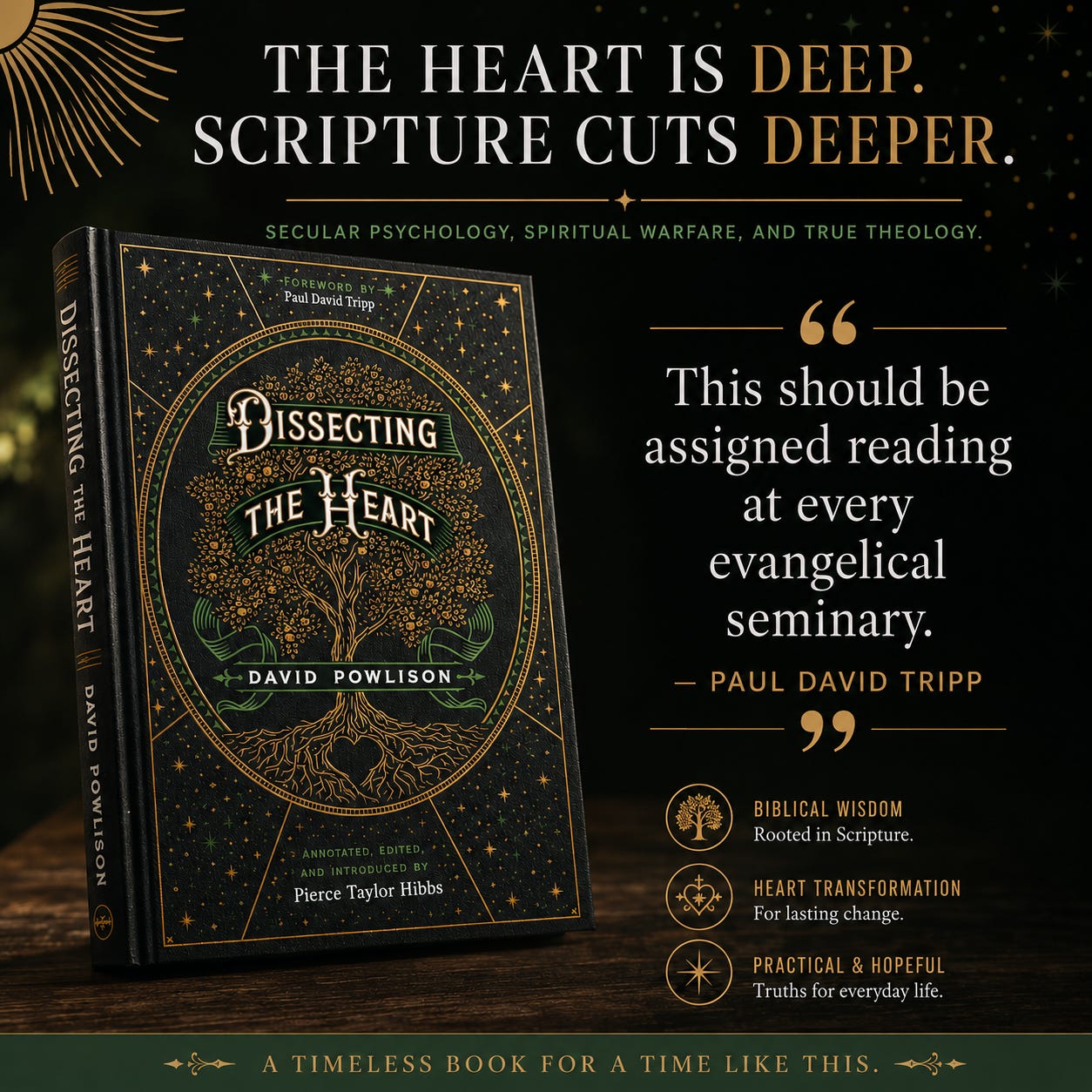
In Dissecting the Heart (28-30), the late biblical counselor David Powlison says there are three questions that people struggle to answer in the realm of psychology and spirituality. In fact, the church tries to answer these questions while the broader culture wages war with its own answers. It’s a war of influence, waged for the affection and trust of every soul.
- Who is right? Whose view of the human condition—including our motives and grasp of truth—is correct? For instance, are we strictly earth-bound beings with no transcendent destiny, as Western secular culture suggests? Or are we creatures with eternity in our hearts (Eccl. 3:11) who cannot find satisfaction apart from the Father, Son, and Holy Spirit (John 7:37)? Is the point of life to “eat, drink, and be merry” as we weather the suffering that comes our way? Or is it to encounter divine change at the heart level, which drastically alters both our longings and how we interpret our suffering? Whose view of human life and reality is right?
- Who has the right? To whom should we give the opportunity to love and help us? Powlison would ask, “Who’s at the end of the referral lines?” When people have a spiritual or psychological problem, whom do they consult? A secular therapist? A pastor? A counselor somewhere between the two? As a culture, to whom are we pushing people for help when confusion, loss, and turmoil surface? Who should care for souls in need?
- Who can make it right? Who holds the deepest solution to human problems and truly makes things better? Who possesses the keys of change? Who can do something about the problems we face? Who can make a difference?
These questions get at the source of truth, care, and power. And whether we know it or not, we all have functional answers. Those answers are based on what we treat as most important. That’s where boats come into play.
Ocean Liners and Lifeboats
Following his list of questions, Powlison introduces the concepts of “ocean liners” and “lifeboats” in order to present one of the most incisive critiques of the evangelical church I’ve ever read. I believe it’s a critique just as applicable now as it was at the time it was given (some thirty years ago). The harsh summary of his message is this:
The church has been blind (not seeing people for the complex, heart-driven creatures they are), deaf (unable to truly and lovingly listen to hurting souls or to the Bible’s true message), and dumb (unable to speak biblical truth into concrete situations leading to change).
He unpacks that critique with two images.
Ocean Liners
Ocean liners are the major questions and conflicts we meet as humans. They seem to be the things that life is all about. They sap our mental energy and call for devoted attention.
- Who am I?
- Am I significant?
- What does my life mean? (What is my purpose?)
- How do I find peace?
- How does hope work?
- Why do I deceive myself?
- Why do I defend myself?
- Why do I have so much internal conflict?
- What do I want/love most?
- What experiences am I chasing, and why?
- How do I respond to trauma or deep pain?
For Powlison, these are the questions that psychology and psychotherapy have been obsessed with for the last two centuries. For example, Sigmund Freud dealt with self-deception, self-defense, and sexuality. New Age psychologists deal with human meaning and purpose as self-created.
But these ocean liner questions are what the Bible is fundamentally about. Think of King David and his wild longing for Bathsheba, along with the train wreck that follows. Think of Moses being called to lead an entire nation after committing homicide and fleeing into the desert. Think of the Pharisees standing tall and proud with a brittle veneer of self-elevating righteousness. Think of Job losing family, wealth, and health in a single day and crumbling to the dust like a pile of rocks. Think of Jesus celebrating a wedding at Cana with friends and family, turning water to wine to increase the joy. The Bible is full of stories that get at the deepest human emotions and the rawest relational experiences. Scripture taps the marrow of the human condition. And yet, Powlison says, the church often misses this. And in doing so, it undervalues the Bible, which is the opposite of what it aims to do.
The Bible is full of stories that get at the deepest human emotions and the rawest relational experiences. Scripture taps the marrow of the human condition.
Lifeboats
Lifeboats are questions and issues that we treat as larger than we should. They hold fewer passengers and help fewer people. And yet, Christians tend to focus on them. Such a focus may not necessarily be wrong, but it ignores the ocean liners that most people are living on. Lifeboat issues are significant, but they can be emphasized to such a degree that the deeper issues of human experience get left behind.
- How do I appear to others in terms of my ethics?
- Do I have the “right” theology?
- Do I do enough spiritual/religious activities?
- Am I experiencing a deep, indescribable connection with God?
- Am I in a regular rhythm of “Christian rituals” (attending church, confessing sin, publicly worshiping, receiving communion)?
- What does the Bible say about my behavior?
Notice that with that final question, it’s very different to ask, what does the Bible say about the desires, motives, identity, addiction, and self-deception that drive my behavior? That would be an ocean liner question.
Lifeboats, again, are not worthless. Ethics matter. Theology matters. Spiritual and religious activity matter. And the Bible certainly talks about behavior. But Powlison’s critique is that the church focuses too much on lifeboats and not enough on ocean liners. How so? That’s the thrust of his critique.
The Thrust of Powlison’s Critique
Rather than focusing on ocean liners of human experience, the church focuses on six lifeboats. Powlison expressed each one as an inward-facing judgment (Dissecting the Heart, 34-37). The bolded text below is his. The explanations are my own.
- We are too external. We think life is all about being good boys and girls. And so we treat Christian faith as a To Do list, rooted in willpower and self-discipline. Incidentally, because all humans are inconsistent, this is likely the reason why many outsiders consider Christians hypocrites.
- We reduce faith to doctrine. Functionally, we believe that Christianity is mostly about getting our theology “right.” True faith is more about correct doctrine than it is about holistic life transformation. Faith becomes more about reading the right books than living from a renewed heart (with new motives, longings, purposes, and values).
- We default to religious activity as an end-all solution. We treat all spiritual and emotional problems as having a quick fix, namely, going to church, joining a small group, reading the Bible, and praying. Do these things, we think, and your addiction will disappear. Your marriage will be restored. Your rebellious kids will start listening to you.
- We are too internal. We notice the superficiality of just trying to be good boys and girls, and so we search for some mystical internal experience to validate our faith. We seek a mountaintop moment or some nebulous sense of “letting go and letting God.” When asked what this actually means, we aren’t sure what to say.
- We fall into religious ritualism. True faith becomes the habitual life. Where the rituals of church attendance, confession, public worship, and communion thrive, we must be doing well. We must be. Right?
- We forget that the word of God is about the ocean liner issues. When we have questions about our identity, grief, addiction, anxiety, or deep passion, we don’t go to Scripture, because we think the Bible isn’t about these things. Instead, we listen to a TedTalk or take a personality test or consult a self-help guru. “Scripture,” we think, “is mainly about morals and dogma.”
Putting all these things together, Powlison portrays the problems of the broader evangelical church as a sort of blindness, deafness, and dumbness. (This is my language, not his.)
Blind
First, the church is blind in the sense that it doesn’t see the true heart struggles of people on the ocean liners of life. It doesn’t see their soul-grappling—the deep and sincere questioning, confusion, and passion driving or pulling them. The church focuses mainly on exteriors (moral behavior), doctrine (right belief, theology), and activity when people really need help at a far deeper level: facing stubborn and unexplainable anxiety or depression, loving someone in a seemingly “unsolvable” broken marriage, guiding a child encountering sexuality and identity issues, standing up to addictions that sap life of its vigor and destroy relationships. There are no quick and easy “fixes” to things like this. The depth and complexity of such experiences call for long term care aimed at roots rather than shoots of human life. And we only get at roots by digging.
The depth and complexity of such experiences call for long term care aimed at roots rather than shoots of human life. And we only get at roots by digging.
What might a biblical response to ocean liner issues look like? Hard and long conversations; extensive and prayerful searching of Scripture; unpacking the word of God for this problem, not for “life in general.” For example, Powlison mines Psalm 10 for a better understanding of evil, and then he applies it to the nature of suffering physical or sexual abuse. (See the chapter entitled “Unfixable Suffering: Psalm 10 on Suffering and Our Savior.”)
If the church doesn’t see people on the ocean liners, it can’t help them. In terms of the major questions we looked at, the church might believe it is right on a moral issue, but it won’t have the right to help more specifically, and therefore it will not even have the chance to make it right. To people on the ocean liners, the church will appear out-of-touch and irrelevant.
Deaf
Second, the church is deaf because it isn’t (1) hearing voices from the ocean liners or (2) hearing the word of God as rightly focused on the heart—the sacred insides of humanity. On the first front, when people encounter life-altering situations—addiction, sexual brokenness, grief, crippling anxiety, chronic illness—the church is not truly hearing them in the sense that it devotes time and attention to listening, understanding, and searching Scripture alongside them. The church hears whispers from the lifeboats (e.g., the importance of ethics and doctrine, the role of religious activity and rituals), but not the screams calling attention to the depths of the human condition. Why? It’s hard to say. Perhaps the church feels unequipped to speak into issues such as identity or grief beyond giving general platitudes or fridge-magnet Bible verses. Perhaps true biblical responses to ocean liner issues are inefficient, and we aren’t willing to delve deeply into a relationship that disrupts our routine. Whatever the reason, people with ocean liner issues are not being heard while people on the lifeboats are. And so it’s no surprise that folks on the ocean liners are disenchanted with the church, if not hostile towards it.
On the second front, the church continues to struggle with hearing God’s word as a message to the heart. What does this mean? It means that Scripture does not have the primary focus of helping people “behave better.” Changes in behavior are changes rooted in the heart (Matt. 15:18-19). The Bible is about the pith of humanity, the deepest part of who we are. It is a story written to the depths of living, breathing people within a web of real relationships and messy problems. And so it asks them the deeper questions and points them to Christ: What are you chasing (Matt. 6:24)? Why do you lie to yourself (1 Cor. 3:18)? How do you keeping going after indescribable loss (the book of Job)? Where do we find hope in the face of death (1 Cor. 15)? Christ will answer each of these questions, but with detail that none of us can fathom, and on a timeline we cannot mark out.
Hearing and applying God’s word as a message to human hearts is an invitation to weave the Bible into the narratives of detailed lives for months, years, and decades. It is not a short game. It is not about quick conversion and easy change. Just as hearing from people on ocean liners is inefficient, so is hearing Scripture as a word to the heart. Love has nothing to do with efficiency. It has everything to do with long patience, quiet presence, and a willingness to learn how God’s speech can shape us—even when we don’t want it to. That’s why the Bible can be described as God’s love letter to the church: reading it, and letting it read us, is a lifelong exercise.
The Bible is about the pith of humanity, the deepest part of who we are. It is a story written to the depths of living, breathing people within a web of real relationships and messy problems.
Dumb
Third, the church is dumb in the sense that it can’t speak to people stuck in the most painful and difficult places. In such places, Powlison argued that Christians and non-Christians gravitate towards either secular psychology or super-spirituality (so-called “deliverance ministry,” where casting out demons is the answer to besetting sins and unfixable suffering). Why? Because the church seems to have nothing helpful to say. (This gets at the who has the right? and who can make it right? questions). Think about it. What would a common church goer say to the following? “I’m so overwhelmed with anxiety that I can’t even leave my house most days. I’m not eating or sleeping, and my life feels skeletal.” Be candid.
As an anxiety sufferer myself, I once said these words to Christian friends and family. Do you know how most of them responded?
- “But you’re a Christian. You don’t have anything to worry about.”
- “God is in control.”
- “Are you reading your Bible?”
- “Matthew 6 says not to be anxious about anything, so . . .”
- “God says perfect love casts out fear (1 John 4:18), so . . .”
- “God has a purpose for this.”
There are grains of truth in some of what they said, but on the whole my response as an ocean liner passenger was, “Wow. You really don’t get it, do you?” I was screaming from the deck rails of an ocean liner. They thought a lifeboat solution would do the trick.
The church cannot speak about ocean liner issues unless it is prepared to observe with fixation, listen in love, and mine Scripture for its riches as if life depended on it (because it does). I ended up writing Struck Down but Not Destroyed because I couldn’t find a book that addressed anxiety with first-person awareness, deep biblical wisdom, and raw observation of what anxiety looks and feels like, especially for Christians striving to be faithful in the midst of it. (A second book, Peace in His Presence, is forthcoming with The Daily Grace Company). To do this in a way that shows how Scripture truly speaks to our anxiety took years. But so what? Is there something else worth our time and attention?
I was screaming from the deck rails of an ocean liner. They thought a lifeboat solution would do the trick.
Powlison often remarked that it was secular psychologists and therapists who went into ridiculous detail observing human behavior: whether its physiological roots or its social manifestations. Why don’t people in the church study something like “defense mechanisms” with the intensity that Freud did? He went all in. His methodology and conclusions were wrong because he discarded the truth of Scripture, but at least he was thinking deeply about the ocean liner issue (i.e., why do we respond to things defensively?). David Powlison’s article “Does the Shoe Fit?” makes many insightful comments about self-defense in the midst of critiques. Without thinking deeply and biblically about ocean liner issues, the church will remain dumb, unable to speak to people when they find the courage to shout for help.
Blind to the ocean liners; deaf to their passengers and to the word of God; and dumb when it comes to offering deep wisdom and care—that’s how Powlison critiqued the church.
Keep in mind that Powlison was speaking in generalities and trends. We all (I hope) can identify situations where the church has responded well to people asking ocean liner questions. But, in terms of the noticeable and popular responses in the evangelical church, this is where Powlison saw problems.
Responding
What did Powlison propose as a response? True biblical counseling—an ancient practice with modern proponents who are struggling to answer the three major questions with a Bible in hand. Who is right? Who has the right? Who can make it right? Biblical counseling was meant to answer those questions with both depth and clarity. Powlison said in the early 2000s, “Biblical counseling has only been around for a few decades, but it aims to be a thoughtful, loving, consistent worldview, a practical theology dealing with the problems of people’s lives, relationships, emotions, and so on. It’s a horse to bet on” (Dissecting the Heart, 41). But true biblical counseling is still hard to find, and even harder to practice. This is the task before a new generation of Christians. It will take a lot of time, inefficiency, and loving labor with a open Bible.
How Does This Hit You?
I’m curious as to how Powlison’s critique hits readers today, and even former Christians. I have friends and family who have left the church. When I look at Powlison’s critique, it seems eerily accurate. For many of them, the church was blind, deaf, and dumb. It did not see them, could not hear them, and did not speak to them. It may have had every intention of doing the opposite, but it somehow ignored the complexity and depth of ocean liner issues and focused on lifeboats.
If Powlison was right in his critique of the church, then the task of the next generation is to see, hear, and speak in ways that surprise sufferers and skeptics.
- See: Do we truly see what someone is grappling with? If we don’t, we must ask them to show us, to tell us their story. That doesn’t mean their story will be “the whole truth and nothing but the truth,” but it’s a start. We cannot begin by assuming that people are living in lifeboats. Most of them are on the ocean liners of human experience. They are dealing with massive questions about identity, suffering, love, loss, and purpose. We will not see them if we remain fixated on the lifeboats.
- Hear: Hearing other people involves active listening (not just waiting for our turn to speak). And hearing the word of God as a word to the heart means listening for more than “right doctrine.” God wants all of us—the heart, the head, and everything in between. God’s word is about that. When we think it’s about something less, we misread it.
- Speak: Applying biblical truth to personal pain and problems will take a lot of exegetical and prayerful work. Scripture gets into so much more than codes of behavior. It has much more to say to someone battling anxiety than, “Don’t be anxious.” But to truly speak into the lives of people living on ocean liners, we’ve got a lot of work to do. And God has given us his Spirit so that we can do it! Until we delve headlong into Scripture with a problem to work out, we will remain dumb in the presence of those with real pain. And those people will look elsewhere for help.
Learn more about David Powlison’s thought and theology.

.jpg)

.jpg)
.jpg)